Gold Beach And Arromanches: The British Sector Explained
Gold Beach was the middle of the five D-Day landing zones and the sector where the invasion's engineering ambition is still visible in the water. At Arromanches-les-Bains the steel and concrete caissons of the artificial Mulberry harbour sit a few meters from shore, and the museums and memorials around them tell the British and Canadian side of 6 June 1944.
Short answer
Gold Beach sits at Arromanches-les-Bains, about 10 km northeast of Bayeux, and is the easiest D-Day site to read at a glance because the Mulberry harbour caissons remain in the water. Museum entry costs 12.90 euros for the Musee du Debarquement and about 7 euros for Arromanches 360. Guided tours of the sector run from Caen from $169 per person.
Gold Beach was one of the two British landing sectors on 6 June 1944, wedged between the American beaches to the west and the Canadian and British beaches to the east. About 160,000 Allied troops came ashore across the five beaches that day, including about 73,000 Americans, and Gold is where the invasion's most visible engineering legacy still stands half-sunk in the English Channel. The village of Arromanches-les-Bains was chosen before the landings as the site of an artificial port, and the concrete caissons towed across from England in the days after D-Day remain there now, close enough to walk to at low tide. If you're weighing how Gold stacks up against the other sectors for a day of touring, the guide to choosing the best D-Day beach to visit compares scenery, museums and crowds across all five.
Most visitors arrive through Bayeux or Caen and spend a stop or two here as part of a wider day covering the American beaches. That works, but it sells the British sector short. Arromanches rewards a slower look, and the tours built around it, from a half-day van trip out of Caen to a four-hour bike ride along the flat coastal road, are among the more distinctive ways to see the Normandy coast. This page lays out what actually happened at Gold, what you can still see, and which guided options run there, with the prices and inclusions each listing states.
What Happened At Gold Beach On D-Day?
On 6 June 1944 Gold Beach was the landing sector assigned to British forces, sitting between Omaha Beach to the west and Juno Beach to the east, with the small port town of Arromanches-les-Bains just behind it. British troops came ashore against defended positions and pushed inland several kilometers by the end of the day. The beach code name survives in local road signs and museum names more than in physical scars.
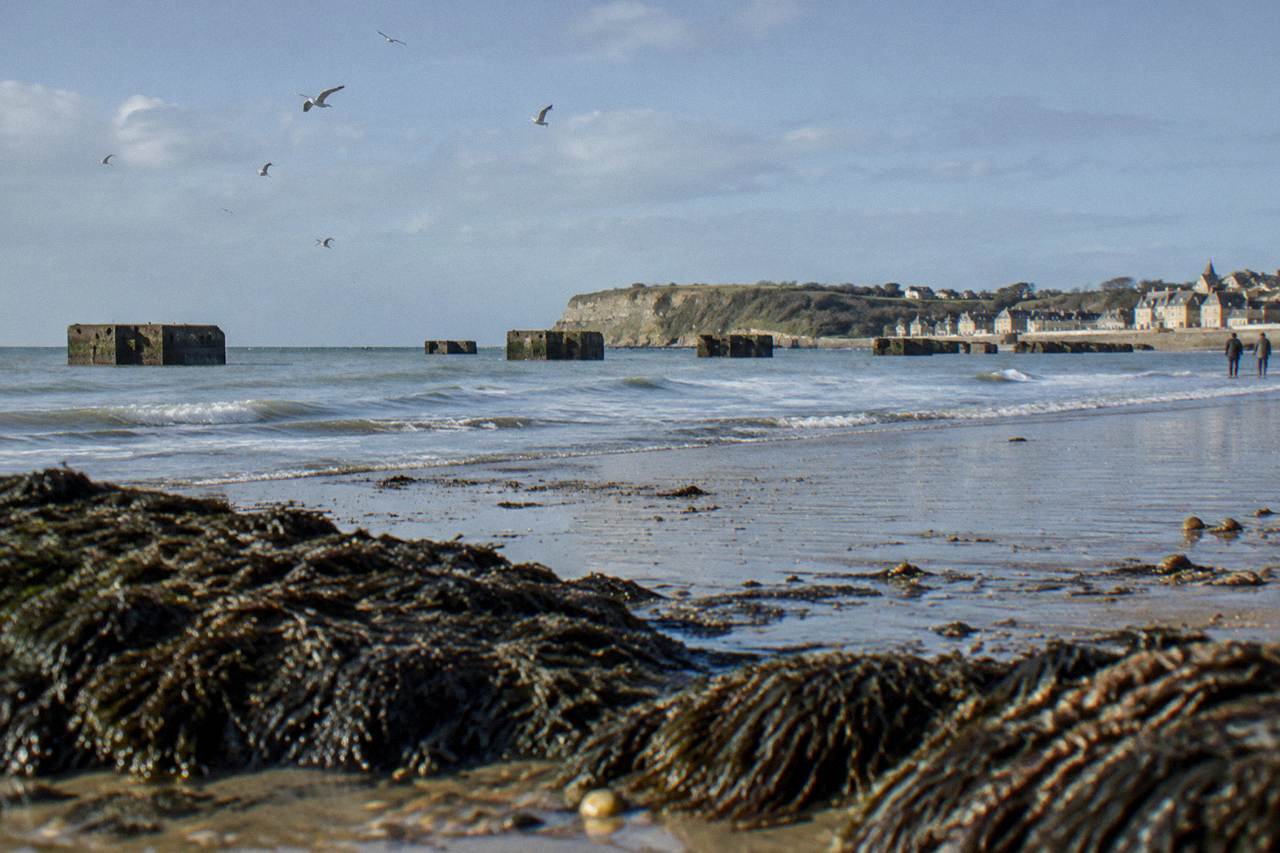
The five landing beaches ran west to east as Utah and Omaha for the Americans, then Gold for the British, Juno for the Canadians and Sword for the British again. Gold's value to the invasion plan was not the beach itself but the gentle shelving bay at Arromanches, which Allied planners had identified in advance as a place where an artificial harbor could be anchored. Once the beachhead was secure, tugboats towed enormous concrete caissons across the Channel and sank them in a line to form a breakwater. The structure was named a Mulberry harbour.
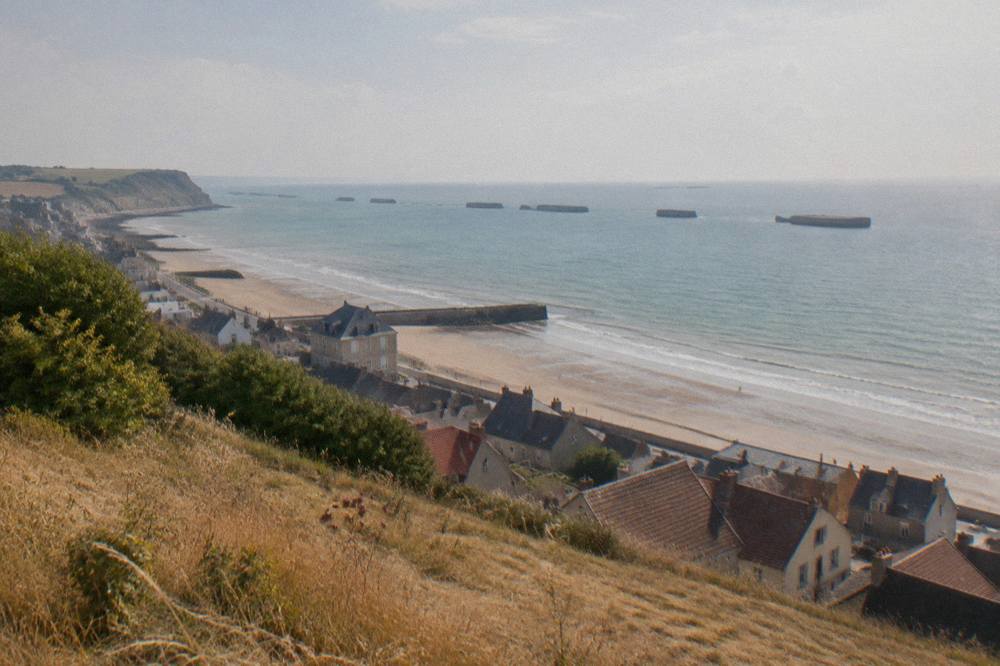
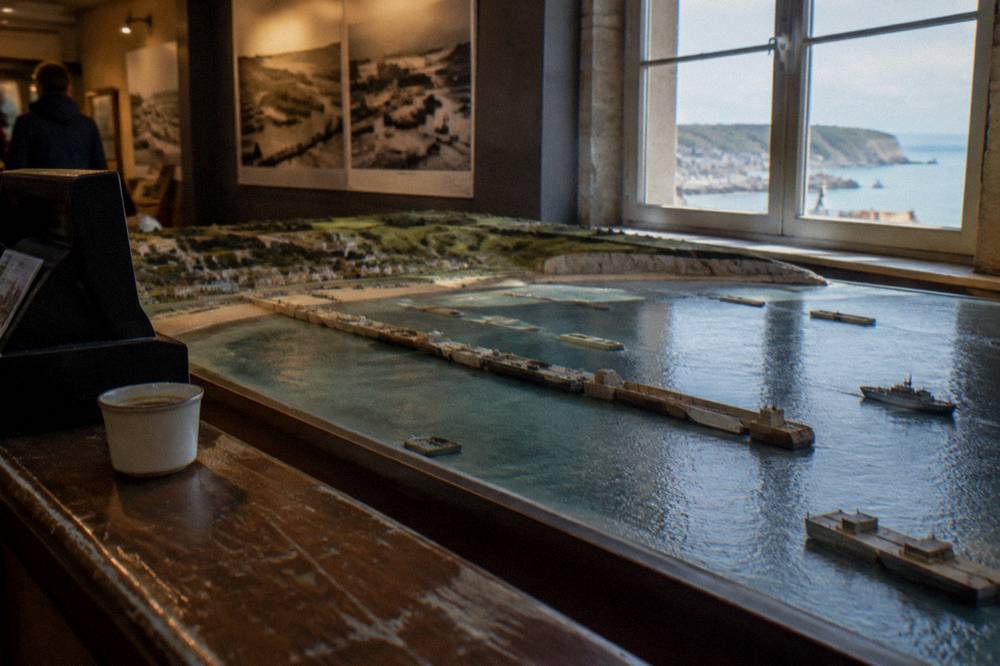
The scale is hard to picture from the shore description alone, so go and look. From the clifftop path or the seawall at Arromanches the caissons stretch across the bay, rusted and barnacled, some broken open by winter storms across eight decades. They are the reason the invasion could supply itself in the weeks after the landings, when the captured deep-water ports were still in German hands or wrecked. Museums in the village and on the bluff above it explain the engineering with models and film, and their entry prices are covered further down this page.
The sector's story continues inland. The From Gold Beach to Caen tour, a four-hour guided van trip from the Caen Memorial, follows that push east with stops at Arromanches, the British Normandy Memorial and the Beny-sur-Mer Canadian War Cemetery, from $169 per person with a certified Memorial de Caen guide. If your interest is the British and Canadian experience rather than the American one, that family of tours is covered in detail in the Juno Beach Canadian sector guide.
What Can You Still See At Arromanches Today?
The visible remains at Arromanches are the Mulberry harbour caissons standing in the bay, viewable free from the seawall and clifftop path, plus two paid sites: the Musee du Debarquement on the seafront at 12.90 euros adult entry, and the Arromanches 360 circular cinema on the bluff at about 7 euros. Both museums close for parts of the winter.
Start on the seafront. The museum closest to the beach, the Musee du Debarquement, sits almost in the shadow of the caissons and concentrates on the artificial port itself, with sections of the original structure built into the displays and an audioguide included in the ticket. Seasonal opening hours apply, running longer from May to August and shorter in the shoulder months, with closures in early January and over several late-December dates. Hours and prices are stated on the museum's own prices page.
Above the village, reached by a steep road or a short drive, the Arromanches 360 circular cinema projects archival footage of the landings on a circular screen. The film runs on a continuous loop with no fixed start time, which makes it a natural pairing with the seafront museum rather than a substitute for it. Its hours are shorter than the museum's, and it closes on Mondays in November and December, so check the same museum site before planning a winter visit.
The third thing to see costs nothing: the remains themselves. At low tide you can walk out on the sand toward the nearer caissons, though climbing on them is not advisable and the tide returns faster than the flat beach suggests. The clifftop path between Arromanches and Longues-sur-Mer gives the best single overview of the whole harbor line.
A short list keeps the paid stops straight:
| Site at Arromanches | What it covers | Adult price | Notes |
|---|---|---|---|
| Musee du Debarquement | The Mulberry harbour, with original remains and models | 12.90 euros | Audioguide included; seasonal hours |
| Arromanches 360 | Circular cinema with archival footage of the landings | about 7 euros | Shorter hours; closed Mondays in Nov and Dec |
| The bay itself | Harbour caissons visible in the water | Free | Best light and overview from the clifftop path |
Tours that stop at Arromanches as part of a wider day include the From Paris: Normandy D-Day Beaches Day Trip, a 14-hour coach itinerary from a central Paris meeting point that lists Arromanches as its lunch stop alongside Pointe du Hoc, Omaha Beach and the Normandy American Cemetery, from $190 per person.
Which Tours Of The British Sector Run From Caen?
Four tours cover Gold Beach and Arromanches from Caen or the Caen Memorial, ranging from a $169 per person half-day van tour to a $955 per group private car day. The bike option starts from Courseulles-sur-Mer, while the others run from Caen, two of them meeting at the Memorial esplanade.
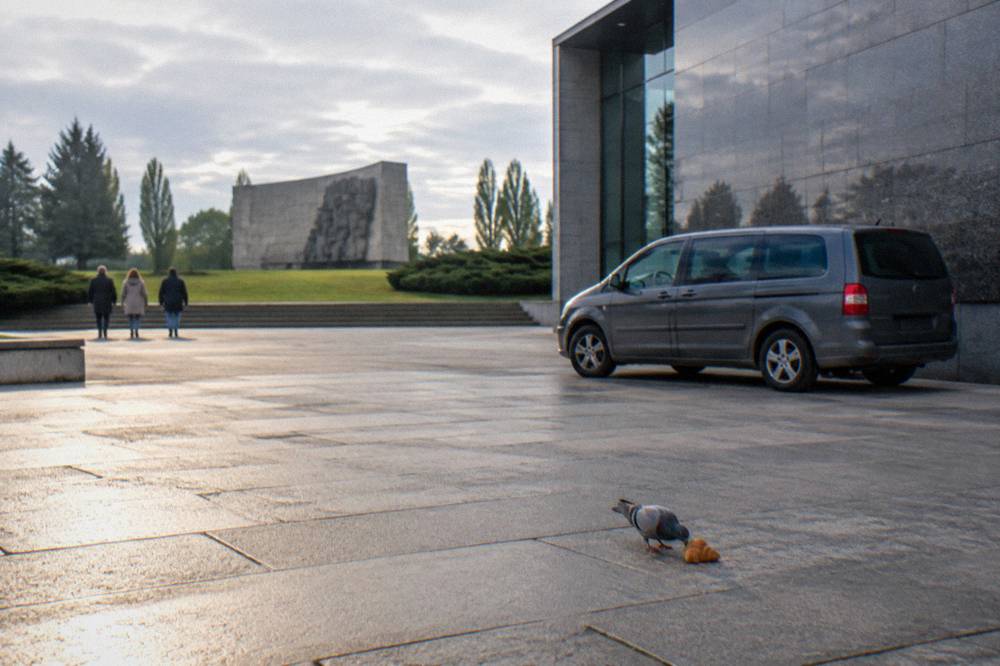
The Caen Memorial is the natural hub for the British sector because it sits on the northern edge of the city with fast road access to the coast, and because its own museum gives the campaign context before you see the ground. The half-day From Gold Beach to Caen tour, one of the shorter options among the British and Canadian beach tours covered here, meets at the Memorial esplanade and takes a van of up to seven people to Arromanches for a guided tour, then to the British Normandy Memorial and the Beny-sur-Mer Canadian War Cemetery, with an entrance ticket to the Memorial museum included in the fare. Four hours, from $169 per person, free cancellation listed. It is a good pairing for a two-stop Caen day: museum in the morning, ground in the afternoon.
The full-day tour from the same operator, the Gold, Juno and Omaha guided small group tour, widens the loop to ten hours and adds Pointe du Hoc and the Normandy American Cemetery, with lunch at the Memorial de Caen bistro listed as included, from $275 per person. The Gold, Juno and Omaha guided small group tour is the only Caen departure that crosses both sectors in one day, and its stop list reflects that: Arromanches, the British Normandy Memorial, the Ardenne Canadian War Memorial, Pointe du Hoc and the American Cemetery.
A note on ratings, because it matters for how you read the sector. The From Gold Beach to Caen tour has 11 reviews and the Gold, Juno and Omaha full-day has 12, so their 4.7 and 5.0 scores rest on small pools. For contrast, the most reviewed trip covered here, the Paris day trip to the American sector, carries 4.8 across 10,452 reviews. Small pool does not mean poor quality; it means unproven at scale, which is a fair reason to prefer a free-cancellation listing when trying a newer product.
The private option is the British Sector D-Day Discovery Tour, a nine-hour private car day for up to four people at from $955 per group, with pickup in Caen, food and drinks listed as included, and stops that add Sword Beach, Pegasus Bridge, the Cafe Gondree and the Merville Battery to the Gold Beach core. It has two reviews. That is the itinerary for visitors whose interest runs to the airborne and Pegasus story as much as the beaches, and the per-group price splits differently for three or four travelers than for one.
| Caen departure | Duration | Price basis | Stops listed | Reviews |
|---|---|---|---|---|
| From Gold Beach to Caen | 4 hours | from $169 per person | Arromanches, British Normandy Memorial, Beny-sur-Mer cemetery | 4.7 from 11 reviews |
| Gold, Juno and Omaha small group | 10 hours | from $275 per person | Arromanches, British Memorial, Ardenne, Pointe du Hoc, American Cemetery | 5.0 from 12 reviews |
| British Sector private discovery | 9 hours | from $955 per group | Sword, Juno, Gold, British Memorial, Pegasus Bridge | 5.0 from 2 reviews |
Is The Juno And Gold Beach Bike Tour Worth Booking?
The Juno and Gold Beach guided bike tour is a four-hour ride from Courseulles-sur-Mer to Arromanches and back, from $247 per person, with a bike, helmet, one snack and a drink included. It is a new listing with no reviews yet, and it is a way to see the Mulberry harbor and the British Normandy Memorial at a pace slower than a van.
The route makes sense on a map. Courseulles-sur-Mer, where the tour meets at the Hotel-Restaurant La Cremaillere, sits on Juno Beach at the Juno Beach Centre. From there the coast road runs flat and westward through the Canadian sector to the British Normandy Memorial above Ver-sur-Mer, then on to Arromanches, with the Mulberry caissons in view for the final stretch. Listed stops include the Juno Beach Centre, the Arromanches 360 cinema, the remains of the artificial port, a restored windmill at La Pierre Solain and the British Memorial. Regular and electric bicycles are both offered.
Four hours on this terrain suits most reasonably active riders. Normandy's coast here is low, the road is quiet out of season, and the distance is modest rather than sporting. What you gain over a van is the ability to stop at the clifftop between Ver-sur-Mer and Arromanches, one of the best viewpoints on the British coast, without blocking traffic or a driver's schedule. What you lose is museum depth: the 360 stop is a stop, not a full visit, so check the listing for exactly what time is allowed at each point.
The caveat is the listing's youth. It has no ratings or reviews yet, so there is no traveler signal either way. The price is firm at from $247 per person, free cancellation is listed, and the operator provides the equipment, so the main open question is guide quality, which only early guests can answer. Booking with free cancellation in place is the reasonable way to take that chance.
One planning note: the tour starts in Courseulles-sur-Mer, not Caen or Bayeux, so it pairs naturally with a night in the Juno sector rather than a morning dash from elsewhere. Whether Caen or Bayeux makes the better base depends on which sector dominates your itinerary, and Courseulles tips that answer toward neither, being a short drive from each.
What About The Longues-sur-Mer Battery?
The Longues-sur-Mer German battery stands on the clifftop between Arromanches and Port-en-Bessin, with its four gun casemates and fire-control post still in place. The site is free to walk around, but the observation post has been closed to visitors since 2025 because of cliff-collapse risk. No hours or entry price are published for the site.
The battery is one of the few places on the coast where the German side of 6 June is physically intact. The casemates face the sea across the same bay the Mulberry harbour filled, and the fire-control post perches on the cliff edge the erosion now threatens. Walking the site takes under an hour and explains, better than any diagram, why the naval duel on the morning of the landings mattered to everything that followed. The Paris minibus full-day tour lists Longues-sur-Mer as a stop alongside Omaha Beach, the Overlord Museum, Pointe du Hoc and the American Cemetery, from $298 per person in a group of up to eight. The rest of the planning pages sit on Normandy D-Day Tour.
Because the observation post is closed, do not plan an interior look. The casemates themselves remain viewable from outside, and the site is managed ground rather than a ticketed museum, so there is no published opening schedule or price to check. Wind and weather are the real variables: the clifftop is exposed, and fog can swallow the sea view entirely. Treat it as a forty-minute stop between Arromanches and the American sector rather than a destination in its own right.
Where Does The British Normandy Memorial Fit In?
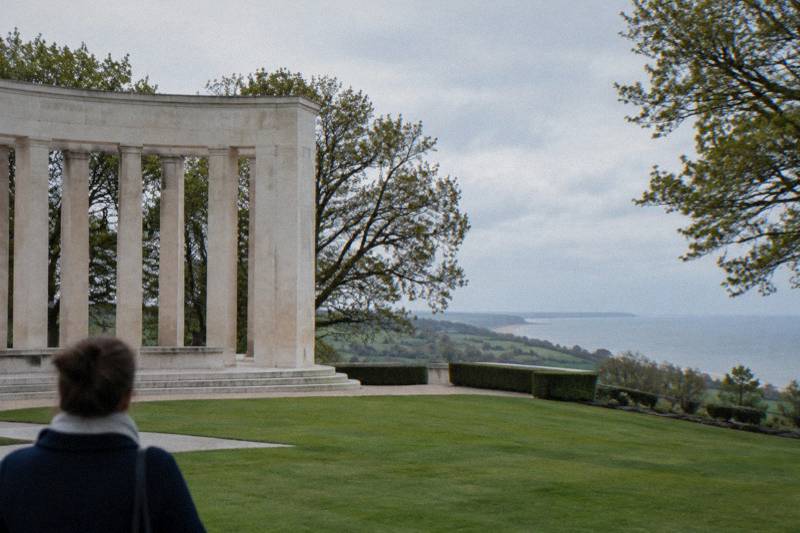
The British Normandy Memorial stands on the heights above Gold Beach at Ver-sur-Mer and records the names of British service personnel who died in the Normandy campaign. Opened in recent years, it is the sector's principal British commemorative site, and it appears in the stop lists of the Gold Beach to Caen tour, the full-day Gold, Juno and Omaha tour and the bike tour.
The memorial faces the sea across the ground British forces crossed on 6 June 1944, and its position is its point: from the colonnade you look down over Gold Beach itself. Ceremonies are held here each early June, and the 2026 anniversary program included a remembrance event at the site alongside the main ceremony at the Normandy American Cemetery, which 29 World War II veterans attended. The June anniversary week brings road restrictions and heavy congestion across the coast between Bayeux, Arromanches and Sainte-Mere-Eglise, and lodging in Bayeux and Caen books out months ahead for that period, so travelers targeting the commemorations should plan far in advance or aim for the shoulder months instead.
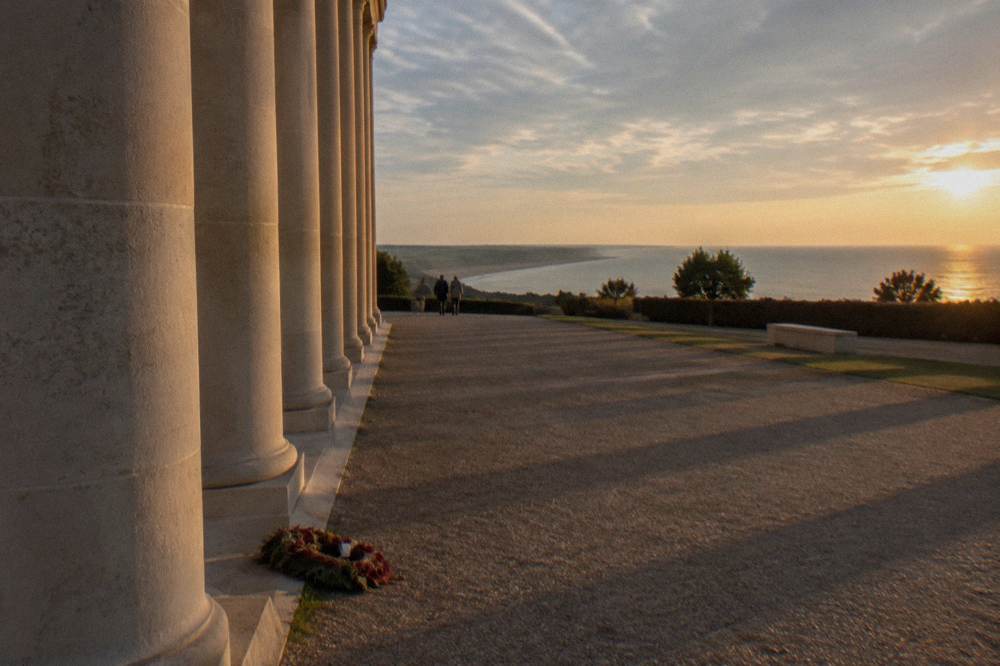
For everyday visiting, the memorial is open ground, free to enter and somber by design. The D-Day sites draw around 1.8 million visitors a year across the corridor, and this end of the coast carries a fraction of the Omaha crowds, which is part of the case for the British sector in general: more standing room, less queueing, the same weight of history.
How Much Does A Gold Beach Day Cost In Total?
Counting transport, the Musee du Debarquement at 12.90 euros and the 360 cinema at about 7 euros, an independent day built on the two Arromanches museum tickets costs a fraction of any guided option, while the guided range runs from $169 per person for the Caen half-day to $275 per person for the full-day small-group tour with lunch included. Museum tickets are bought on site; tour prices are those on the live booking pages.
The biggest single variable is whether a guide drives you or you drive yourself. A self-driven day, with the Musee du Debarquement at 12.90 euros, the 360 cinema at about 7 euros and fuel between Bayeux, Longues-sur-Mer and Ver-sur-Mer, costs less than any guided option but leaves you to read the ground alone, and the British sector is thinner on interpretive signage than the American beaches. The Caen half-day tour at from $169 with its included Memorial ticket is the midpoint, and the full-day at from $275 is the top of the standard range.
| Item | Cost | Basis |
|---|---|---|
| Musee du Debarquement, Arromanches | 12.90 euros | adult, audioguide included |
| Arromanches 360 circular cinema | about 7 euros | adult |
| From Gold Beach to Caen tour | from $169 | per person, 4 hours, Memorial ticket included |
| Gold, Juno and Omaha full-day tour | from $275 | per person, 10 hours, lunch listed |
| Juno and Gold bike tour | from $247 | per person, 4 hours, bike and snack included |
| British Sector private day | from $955 | per group, up to 4 |
One cost that is easy to overlook is the Caen Memorial ticket itself, at 20.80 euros adult, since the half-day tour includes it and the full-day tour includes both it and lunch. If you were buying the museum separately anyway, the effective premium for the guided van is smaller than the headline prices suggest. Train fares from Paris run about 17 to 90 euros each way to Bayeux depending on how far ahead you book, which is covered in detail in the train guide.
How Do Gold And Arromanches Compare With The American Sector?
Gold Beach and Arromanches offer quieter ground, lower museum crowds and the only visible remains of the artificial harbour, while the American sector offers the highest-rated and most reviewed tours, the Normandy American Cemetery and Pointe du Hoc. A trip of two days or more can cover both; a single forced day usually serves American-sector priorities best. If you're wondering what actually survives on the ground today, the guide to the wreckage still visible at Normandy's beaches covers the harbour blocks, bunkers and museum artifacts you can still see.
The comparison matters because most first-time visitors arrive with an American-sector itinerary in mind, built around Omaha Beach and the cemetery at Colleville-sur-Mer, which the American Battle Monuments Commission keeps open daily from 9 a.m. to 5 p.m. with free admission, per the ABMC's Normandy pages. Adding Arromanches to that day is easy, since the coast road strings them together, and the big Paris coach itineraries do exactly that, with the 14-hour Extime coach trip from Paris stopping at Arromanches for lunch.
But a British-sector day is a different experience rather than a lesser one. The groups are smaller, the Caen Memorial anchoring it is one of Normandy's strongest museums, and the harbour remains give the sector a physical artifact the other beaches lack. Travelers with a family connection to British or Canadian forces, or an interest in engineering history, often find a full Gold and Juno day more rewarding than a second pass over Omaha. The full-day Gold, Juno and Omaha tour exists precisely for the undecided, stitching both sectors into one ten-hour loop.
For a wider comparison of how the guided market splits, the private versus small-group analysis walks through the trade-offs, and the same logic applies to the British sector's van tours. Whatever you choose, free cancellation is listed on every Gold Beach-area tour named on this page, so booking early and adjusting later carries little risk.
Common Questions About Gold Beach And Arromanches
Can you see the Mulberry harbour remains without paying?
Yes. The caissons sit permanently in the bay at Arromanches and are visible free from the seawall, the beach and the clifftop path. Only the two museums, the seafront Musee du Debarquement at 12.90 euros and the Arromanches 360 cinema at about 7 euros, charge entry.
Is Gold Beach worth visiting compared with Omaha Beach?
Gold Beach offers the only surviving remains of the artificial harbour, a strong pairing of museums and smaller crowds, while the American sector carries the Normandy American Cemetery, Pointe du Hoc and the most reviewed tours. Many visitors cover both across two days, or take the ten-hour Gold, Juno and Omaha tour from Caen for both in one day.
How do you get to Arromanches from Bayeux or Caen?
Arromanches is about 10 km from Bayeux by road and roughly half an hour from Caen. There is no useful direct public transport along the coast, so most independent visitors drive or cycle; guided tours from Caen depart from the Memorial esplanade.
Why do some Gold Beach tours have so few reviews?
The Gold Beach-area listings are newer products with small review pools, 11, 12 and 2 reviews, and a bike tour with none yet, which is too little traveler signal for a reliable rating. The prices, durations and stop lists are stated instead, and every listing shows free cancellation.
Is the Longues-sur-Mer battery open?
The battery grounds and gun casemates can be viewed, but the cliff-edge observation post has been closed to visitors since 2025 because of cliff-collapse risk. The site publishes no hours or entry price, so treat it as a short outdoor stop.
When is the best time of year for the Gold Beach sector?
May to September brings the longest museum hours and the most reliable weather, while the shoulder months are quieter. The first week of June, the anniversary period, brings ceremonies, road restrictions and heavy congestion, and hotels around Bayeux and Caen book out months ahead for it.